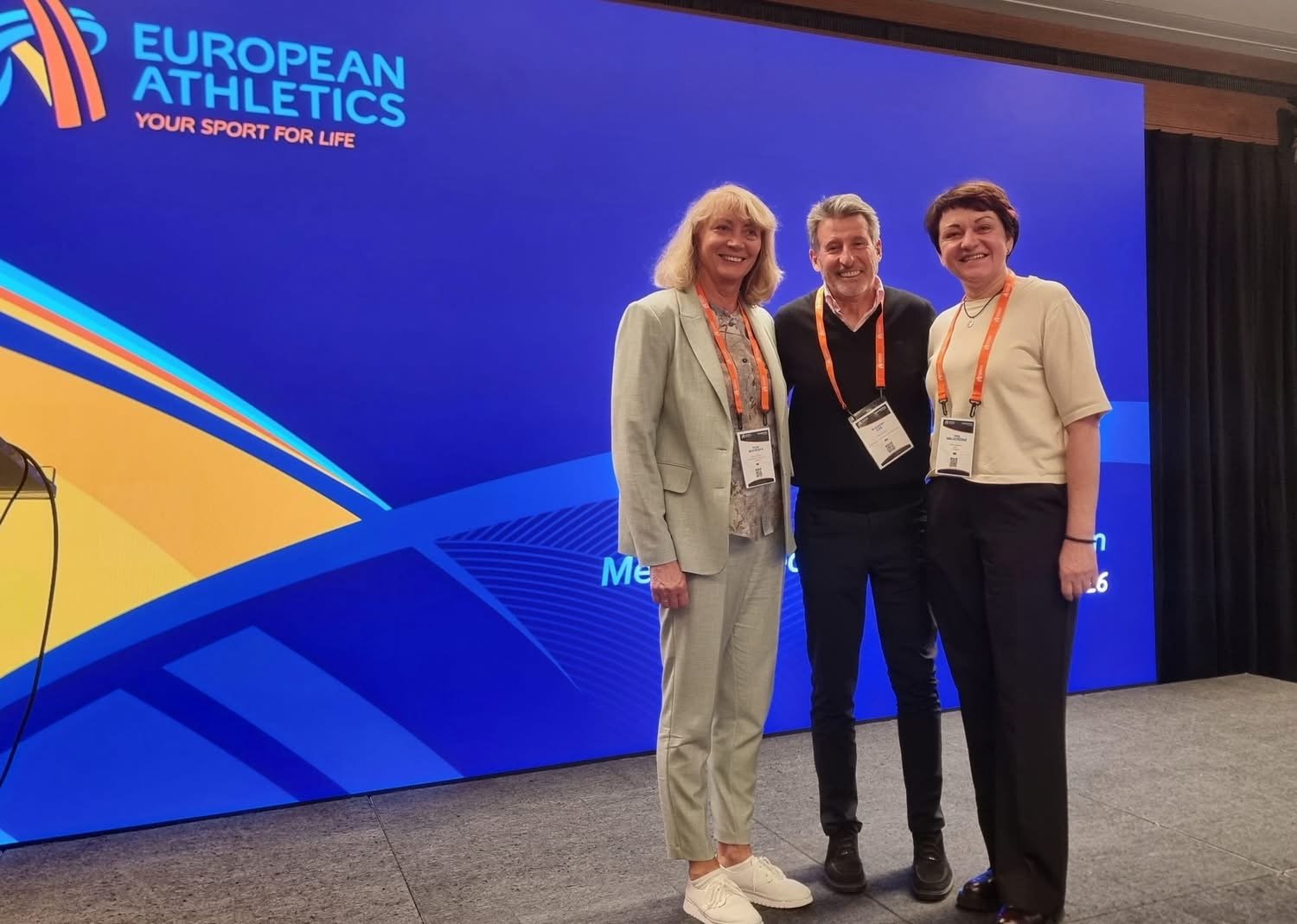
At the European Athletics convention held in Switzerland on October 22–24, federation representatives from across Europe discussed the future of the sport, innovation, public engagement, and responsible governance. Over the course of the three-day event, particular attention was given to attracting new audiences, digitalization, and collaboration, with the convention culminating in the Golden Tracks awards.
Every year, after the season concludes, the European athletics community gathers at the European Athletics convention to discuss key topics. This year’s convention brought together 325 accredited participants, including 121 delegates from 46 member federations of European Athletics. The Lithuanian Athletics Federation was represented by President Eimantas Skrabulis, Secretary General Nijolė Medvedeva, Vice President Brigita Virbalytė, and Referent Vilija Smilgevičienė.
Five workshop sessions examined the key directions of the European Athletics strategic action plan: increasing the appeal of competitions, accessibility of sport, digital innovation, and responsible organizational governance.
Opening the convention, European Athletics President Dobromir Karamarinov urged participants to share their experience, seek opportunities for cooperation, and build connections that would contribute to the growth of European athletics.
“Today is an extremely important day, because this is where the real work begins,” emphasized D. Karamarinov.
Focus on competition appeal and new audiences
The first day of the convention focused mainly on how to make athletics more appealing to spectators and attract new audiences. The “Making Events Matter” session discussed improving the quality of competitions, increasing their visibility, and enhancing the fan experience, with a particular focus on engaging younger generations.
Participants discussed how modern competition formats, improved event communication, and a more engaging spectator experience could help athletics maintain its standing and attract more sports fans.
Athletics — more open and accessible to all
A significant part of the convention was devoted to accessibility of sport and public engagement. The “Athletics for All” initiative addressed topics such as youth involvement, developing women coaches, and expanding opportunities for diverse groups within society to take part in sport.
Representatives from France, Ireland, and Finland shared their experience and ongoing projects. The discussions emphasized that the development of athletics depends not only on the achievements of elite athletes, but also on opportunities for the broadest possible segment of society to engage in the sport.
Digital innovation and responsible federation governance
The convention introduced the European Athletics Predictor, a forecasting app that uses gamification elements to boost fan engagement and interest in competitions.
The discussion also covered the Swiss Athletics commercial strategy, the importance of community engagement in attracting sponsors, and the development of elite sport. It was emphasized that a strong connection with the sports community can be a key factor in achieving long-term organizational growth.
A separate session was dedicated to federation governance, risk assessment, and long-term organizational sustainability. Discussions highlighted that responsible decision-making is essential to ensuring federations remain stable and able to adapt to a constantly changing sporting environment.
S. Coe on the broader significance of sport for society
On the second day of the convention, participants were joined by World Athletics President Sebastian Coe. The session “Beyond the Scoreboard: Measuring What Makes Sport Matter” explored the significance of sport and the value it creates for society.
It was emphasized that the impact of sport cannot be measured solely by results achieved or financial indicators. Equally important is its social, economic, and societal significance, as well as its ability to bring communities together and contribute to positive change.
The development of amateur running and the strategic direction for 2027 were also discussed, as the search continues for ways to further expand the sport’s audience.
Europe’s best — G. Tamberi and A. Werro
The three-day convention concluded with the Golden Tracks awards ceremony, honoring the best European athletes of 2026.
Italian jumper Gianmarco Tamberi was named European Athlete of the Year, while the women’s award went to Swiss runner Audrey Werro.
In the rising stars categories, Czech runner Michal Rada and Bulgarian jumper Viktoria Angelova triumphed.
After three days of meetings and discussions in Lausanne, it was once again emphasized that the future of European athletics will depend not only on sporting results, but also on the ability to innovate, attract new audiences, strengthen the community, and ensure responsible governance of sports organizations.
The next European Athletics convention will take place in Riga, Latvia, on October 21–23, 2027.